


Reputation management for a small business comes down to four jobs: know what people see when they search your name, keep your listings accurate, earn honest reviews steadily, and answer every review well. Done together, they build trust and help you show up in local search and on Google Maps. We handle this work for local businesses on the Treasure Coast through our reputation management and local SEO service, and the routine below is the one to follow whether you run it in-house or want it taken off your plate.
TL;DR
- Online reputation management is monitoring, influencing and improving what customers say about you online, mainly through reviews and search results.
- Google says local rankings depend on relevance, distance and prominence, and that review count and ratings feed prominence.
- Never offer a reward for a positive review. Google prohibits it, and the FTC’s 2024 rule bans fake reviews and sentiment-conditioned incentives.
- Audit first, fix listings second, ask for reviews third, reply to everything, then check on a fixed schedule.
- A website that backs up your reviews turns reputation into calls and booked jobs.
Table of Contents
- What reputation management means for a small business
- Why it pays: what the evidence shows
- Step 1: Audit what customers see today
- Step 2: Claim and correct every listing
- Step 3: Ask for reviews the right way
- Step 4: Reply to every review
- Step 5: Monitor on a schedule
- How reputation connects to Google Maps, search and AI answers
- Doing it yourself or having us do it
- FAQ
- Sources
What reputation management means for a small business
Online reputation management (ORM) is the practice of monitoring, influencing and improving what customers say about your business online. For a local business, that mostly means three places: Google (your Business Profile and the search results for your name), review sites such as Yelp and Facebook, and your own website.
It has two working parts. Review generation is the steady process of encouraging satisfied customers to leave feedback. Response strategy is how you handle feedback, good and bad, promptly and professionally. Everything else is a variation on those two.
It is not a crisis service for big brands. Wharton’s small-business guidance notes that a great reputation helps attract more leads, and a plumber, dentist or restaurant in Stuart or Vero Beach is judged on the same star rating as a national chain.
Why it pays: what the evidence shows
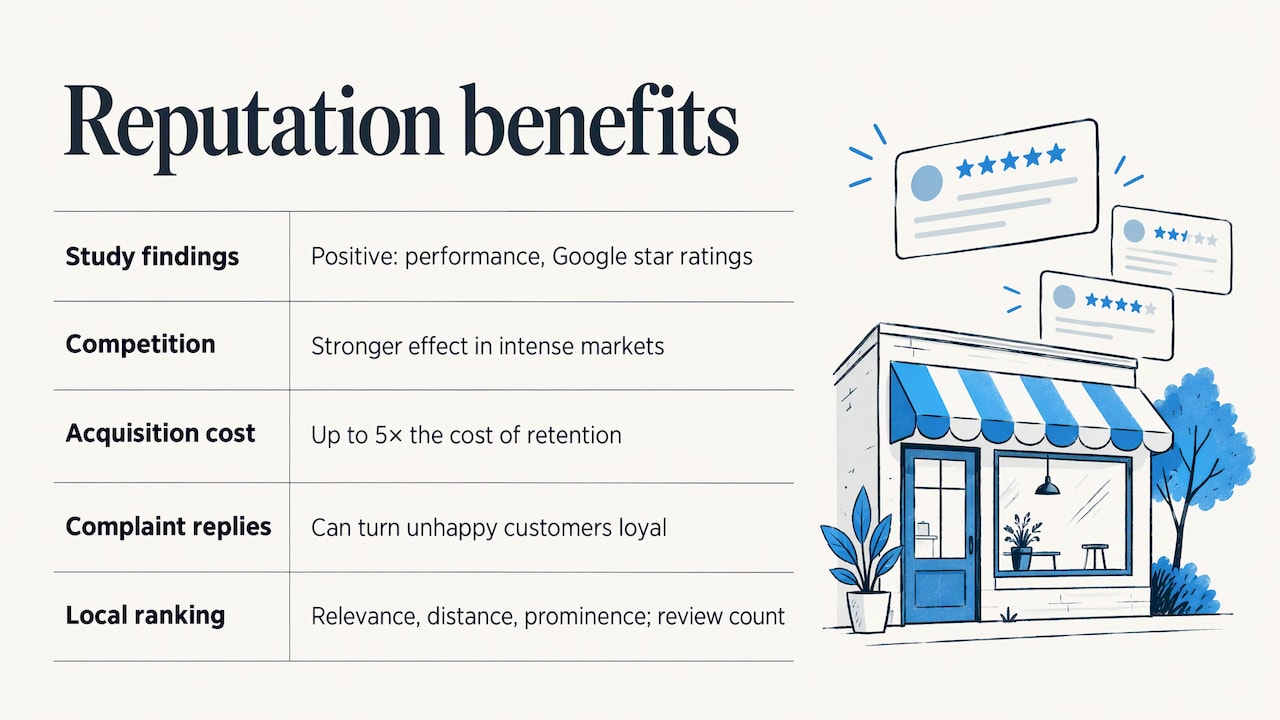
A January 2026 study in the Journal of Small Business Strategy found that online reputation management has a significant positive effect on small business performance and on Google star ratings. The authors also found the effect was stronger where competition was more intense, which describes most local service markets.
The retention side matters too. The Better Business Bureau says it can cost up to five times more to win a new customer than to keep an existing one, and that responding quickly and professionally to complaints can turn unhappy customers into loyal ones. Your reply to a bad review is therefore a retention tool as well as a public statement.
There is a search benefit as well. Google states that local results are mainly based on relevance, distance and prominence, and that prominence draws on how many reviews a business has. More reviews and positive ratings can help your local ranking.
Step 1: Audit what customers see today
Before you change anything, record the starting point. Forbes Advisor recommends searching your business name in an incognito window and reviewing the first page of results and your Google Business Profile.
Do this:
- Search your exact business name, common misspellings, and your service plus city (for example, “roofer Port St. Lucie”).
- Note what appears on page one: your site, profiles, reviews, news, anything unflattering.
- Read your recent reviews on each platform and write down the themes: slow response, pricing, friendly staff.
- Screenshot everything with the date, so you can measure progress.
The point of the audit is a ranked list of problems: a wrong phone number is urgent, a three-year-old complaint is not. Our SEO audits cover this ground for local businesses, including how your site and listings appear in search.
Step 2: Claim and correct every listing
Inconsistent listings cost you trust and visibility. Google says businesses with complete and accurate information, including address, hours, the right category and attributes, are more likely to show in local search.
Claim and check, at minimum:
- Google Business Profile
- Apple Maps and Bing Places
- Yelp and Facebook
- LinkedIn and the BBB, where relevant
Use the identical name, address and phone number everywhere, add special hours for holidays and storm closures, and choose the most specific primary category. Your Google profile is the single most important listing for a local business, and our Google Business Profile optimization is built around getting it complete and keeping it current.
Step 3: Ask for reviews the right way
Most happy customers never think to review you. Google advises asking customers to review through a direct Google link or a QR code, which removes the hunt for the right page.
Practical timing: ask right after a good moment, when the job is finished, the invoice is paid or the customer thanks you. Put the link in a follow-up text or email, and put the QR code on the receipt, the counter or the truck.
The rules you must follow
This is where small businesses get into trouble.
- Google states that offering incentives, such as free or discounted goods or services, in exchange for posting, changing or removing reviews is prohibited.
- The FTC announced its final rule on fake reviews on August 14, 2024. According to a law firm summary of the rule, it bans fake reviews and incentives conditioned on sentiment, bars managers from demanding insider reviews, prohibits suppressing reviews through threats, and allows civil penalties for knowing violators.
- A neutral prompt is compliant, while a prompt tied to a positive rating is not. In practice, “Leave us a 5-star review and get 10% off” is the kind of offer the ban now covers in contractor marketing.
The safe approach: ask every customer, not just the happy ones, use neutral wording, never reward a rating, and never have staff or relatives post reviews without disclosure. For legal questions about your specific practices, talk to a business attorney.
Step 4: Reply to every review
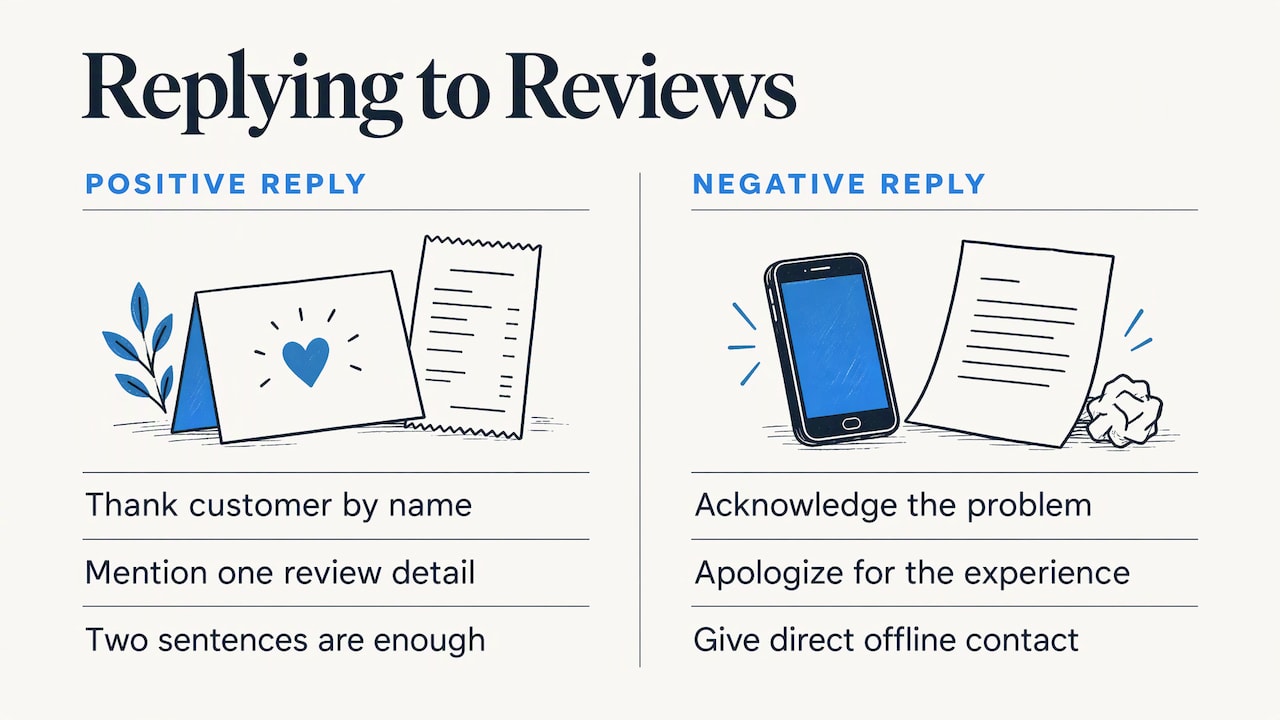
Google’s guidance is to reply professionally and in a timely manner, personalize the reply with the reviewer’s name and details, apologize when appropriate, and move complex issues to phone or email. It also says replies should be conversational, not promotional, so skip the discount offers.
Positive review reply. Thank the customer by name and mention one specific detail from their review. Two sentences is enough.
Negative review reply. Acknowledge the problem, apologize for the experience, and give a direct contact so the details are handled offline. Do not argue facts in public. Future customers read the tone of your reply as much as the complaint.
Example: “Hi Maria, thank you for letting us know about the delay on Tuesday. That is not the standard we aim for. Please call Dan at the office so we can make it right.”
Keep a short internal guide so whoever replies, you or a staff member, sounds the same and responds within a day or two.
Step 5: Monitor on a schedule
Reputation drifts when nobody is watching. Xero’s guide reports that a single negative review can cost a company 30 potential customers and suggests Google Alerts for your name, weekly checks of Google Maps and Yelp, and a monthly search of your business name.
A simple cadence:
| Frequency | Task |
|---|---|
| Weekly | Check new reviews on Google, Yelp and Facebook and reply |
| Monthly | Search your business name in an incognito window and compare with your baseline screenshots |
| Quarterly | Repeat the full audit, update hours, photos and categories |
Forbes Advisor describes the same pattern: regular checks with alerts, plus a deeper quarterly audit.
How reputation connects to Google Maps, search and AI answers
Reviews, listings and your website are signals that search systems read together. Google ties local ranking to review count, ratings and how many websites link to your business, so reputation work and local SEO are the same project seen from two sides.
That is why we pair them. A business with strong reviews but a thin, slow website wastes the trust it earned, while a good website with a neglected profile never gets found. Our guides on how a website improves local SEO rankings and on why a good reputation fails to convert leads into revenue go deeper on the website side.
For AI-driven search, the practical advice is the same: accurate listings, consistent details across the web, steady genuine reviews and a clear website describing what you do and where. Those are the facts any search system can check.
Doing it yourself or having us do it
The routine above is not complicated, but it is relentless. Weekly review checks, timely replies, listing updates and quarterly audits compete with the work that actually pays your bills.
We combine website design with search optimization, tailor strategies to each business and focus on measurable results. For reputation work, that means your Google Business Profile, local SEO and review reputation are handled together with your site, so the trust you earn turns into inquiries. Owners get their time back to run the business.

If you are in Port St. Lucie, Stuart, Vero Beach, Palm Beach Gardens or anywhere on the Treasure Coast, see our reputation management and local SEO service or talk to us through the Treasure Coast Digital Marketing home page.
FAQ
How much does reputation management cost for a small business?
Costs depend on how many locations you have, how many listings need cleanup and how much ongoing monitoring and review handling you want. We do not publish set prices, so the quickest route is a consultation where we scope your audit and ongoing needs.
Can I pay customers or offer discounts for reviews?
No. Google prohibits incentives in exchange for posting, changing or removing reviews, and the FTC’s 2024 rule bans incentives conditioned on sentiment. A neutral request to every customer is the compliant way to ask.
How often should I check my reviews?
Weekly for new reviews and replies, monthly for a search of your business name, and quarterly for a full audit. Fast replies matter most, because they show customers and Google that you value feedback.
Does reputation management help me show up on Google Maps?
Yes. Google says review count and ratings feed the prominence part of local ranking, and complete, accurate profile information makes a business more likely to appear in local search. Reviews work best alongside a fully optimized profile.
Sources
- Online reputation management guide for small businesses (Xero US)
- From Reviews to Revenue: Examining the Impact of Online Reputation Management on Small Business Performance
- Online Small Business Reputation Management Tips (Wharton)
- BBB: Why building trust is critical for small business success
- Online Reputation Management: The Ultimate Guide (Forbes Advisor)
- Tips to improve your local ranking on Google
- Tips to get more reviews (Google Business Profile Help)
- FTC Publishes New Rule Banning Fake Reviews and Testimonials
- The FTC banned fake, deceptive reviews: what it means for contractors

